
LEADERSHIP
DESIGN OPS
UX RESEARCH
READING TIME: 12 MINS
Follow my lead
Zero designers. Zero process. Zero research. I built everything from scratch : team, system, research practice, design culture.
Let me show you how I did it.
The context
When I joined Agorapulse as Head of Design, the company had just closed a €17M funding round and was entering a period of rapid acceleration.
The product was growing, but design quality, UX maturity, and team structure were not scaling at the same pace.
My mission was to build the entire design function from scratch ; team, processes, research practice, design system... to elevate the product experience across web, mobile, and brand touchpoints.
No time to read the whole case study? No worries.
The numbers that matter
0 to 7
Designers built from scratch
5
Core features + 1 Mobile app revamped
5
Squads covered by the Design System
3
Years, one Design department built from zero
Approach & Methodology
1. Visions & Foundations - What we build
To support scale, I established the foundations of a modern product design organization:
→ Built the Design System from scratch, including UI foundations, components, tokens, accessibility and documentation.
→ Defined the information architecture, workflows, and quality benchmarks for product consistency across squads.
→ Standardized design delivery with a shared file structure, review rituals, and clear handoff workflows.
→ Introduced a long-term UX vision and design principles to guide feature teams’ decisions.
Design System Screenshots: (buttons / inputs / snackbars / avatars)
UI components with all states, variations and usage rules

Globally adopted notification patterns with specs, motion, and accessibility rules

Reusable components with clear usage guidance and platform rules

Processes & Guides + Design Quality Definition overview
Centralised hub documenting all design processes, standards, and guidelines

Revamps & User Feedbacks guide
Guideline helping Product & Engineering manage user reactions during major releases

Project Cover + Components view
Standardized feature folders with covers, flows, and component references for smoother handoffs

2. Research & User-Centric Strategy - Why we build it
One of the company’s biggest gaps was the almost total absence of structured user research.
I built a UX Research practice from zero:
→ Created a complete research stack: interviews, surveys, diary studies, usability testing, prototypes.
→ Established continuous discovery with PMs and engineers to align on real user needs.
→ Produced lightweight, actionable research artifacts to democratize insight sharing across teams.
→ Trained the company in research best-practices and made user evidence the default decision driver.
A unified Design Process
To ensure research was fully connected to design and delivery, I created a custom product design process adopted by every squad.
This hybrid model combined the speed of Lean UX with the clarity of the Double Diamond, and structured our work into three phases:
→ Think: discovery, problem framing, user interviews, insights
→ Make: team workshops, ideation, wireframes, prototypes, UI design
→ Check: usability tests, A/B tests, flow validation, frontend reviews
It gave the company a common language, predictable rituals, and a shared methodology that guaranteed consistent quality and user-centered thinking at scale.
The model became the backbone of our UX maturity and was used across all product teams.
Process “Think / Make / Check”
The hybrid Lean UX + Double Diamond process adopted by all product squads

Research & Testing / User Interviews Process
Research playbooks I created to structure interviews, testing, and insight reporting + usability testing workflows used across squads to validate concepts early

Trello Research Board
Research iteration board I designed to guide PMs and designers through consistent discovery practices

Trello Best Practices (Goals / Insights / Screener)
Standardized templates for goals, screeners, insights and action items to ensure research quality at scale


UX Research Agorapulse's Training Program
Internal training program I built to raise UX maturity across the company

Company-wide session on UX strategy, research and product design methodology

3. Metrics, Quality & Business Impact - How we measure it
To ensure design influenced business outcomes, I introduced:
→ UX success metrics tied to onboarding, activation, and workflow efficiency.
→ A cross-functional scoring grid to evaluate clarity, usability, and product coherence.
→ Company-wide UX benchmarking to track improvements from version to version.
→ Collaborative workshops with PMs to link UX actions with retention, adoption, and revenue impact.
UX Metrics Cycle
Standard process to measure impact and validate improvements over time.
Used to benchmark every redesign: measure → improve → measure again

The ROI of UX Workshop - Design & Business Alignment
Training PMs & designers to connect UX changes with measurable business impact.
Enabled the organisation to predict UX ROI and make evidence-based investment decisions

UX KPIs Framework
Guideline to define UX success metrics aligned with product goals.
Baseline method used across squads to ensure comparable metrics for onboarding, activation and efficiency

Team Leadership & Culture
I grew and led a 7-person multidisciplinary team (Product Designers, UX Researcher, Brand Designer) + overseeing the work of several freelance designers for marketing assets.
Key initiatives:
→ Formalized onboarding, growth frameworks, and performance reviews.
→ Mentored each designer individually on craft, strategic thinking, and autonomy.
→ Established a culture of high standards, healthy critique, and continuous improvement.
→ Encouraged designers to own their scope while elevating collaboration with Product and Engineering.
→ My goal: create one of the strongest design teams in the Paris B2B SaaS landscape.
UX Workshops & Rituals
Weekly and monthly rituals to align designers and keep quality high

UX/UI Level-Up Program
A monthly learning program to help designers grow skills in research, writing and UI

Managing Feedback Workshop
Tools and techniques to anticipate reactions, structure critique, and improve communication

User Research Learning Sessions
Internal training to elevate mastery of qualitative and quantitative methods

Learn more about the Design Rituals implemented at 1:16:50
Skills Growth Framework
A competency mapping system used to track progression and set individual development goals

Team Training (NN/g Courses)
Company-supported training accelerating designers’ mastery of advanced UX topics

Hiring Process Frameworks
Clear evaluation methods ensuring fair, structured, and consistent hiring decisions

Design Onboarding Week (in green)
A structured onboarding plan to help new designers ramp up efficiently and confidently

Performance & Craft Evaluation
A transparent scoring system used for performance reviews and craft improvement

Impact & results
Over 3 years, design went from zero to a force multiplier for the entire product organization.
A 7-person team built from scratch. A design system adopted across all squads. A research practice that shaped roadmap decisions. Teams shipping faster, with fewer reworks. Design at the executive table. Got the job done!
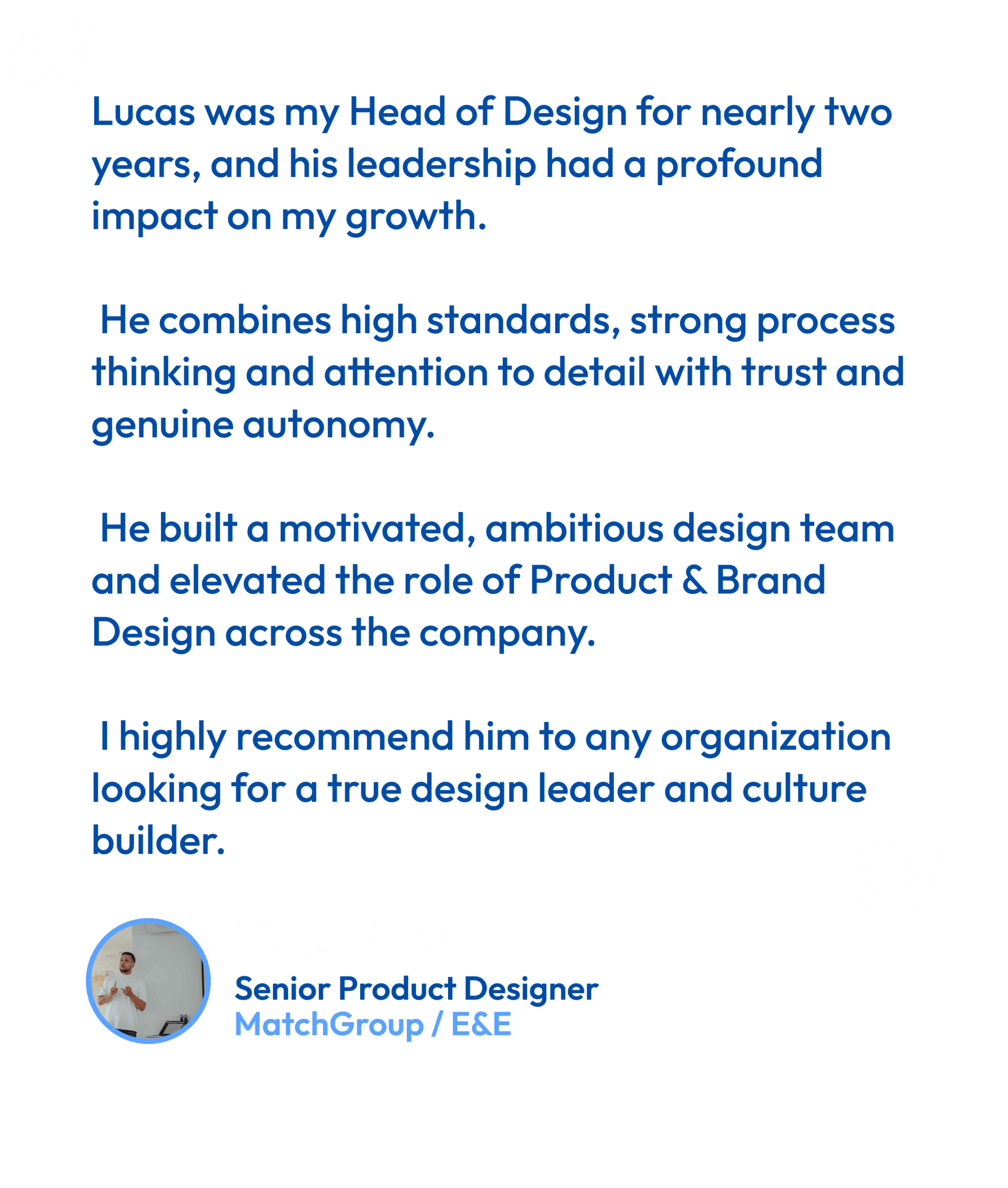
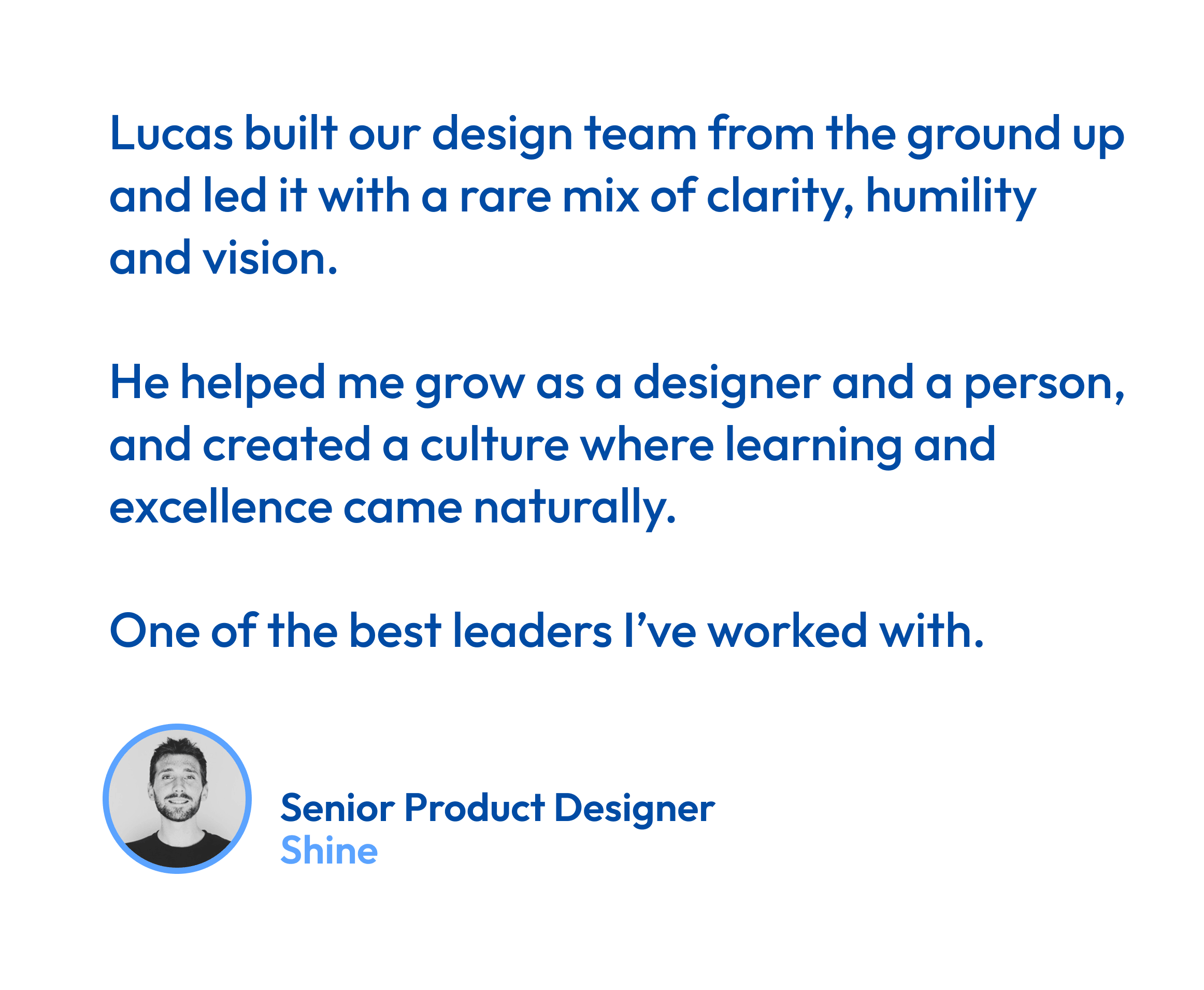
What they said about my work

Want to have a chat?
Made with love and care by Lucas Lengagne, 2026©
(Psst! Wanna know a secret ? I also create underwater films)